

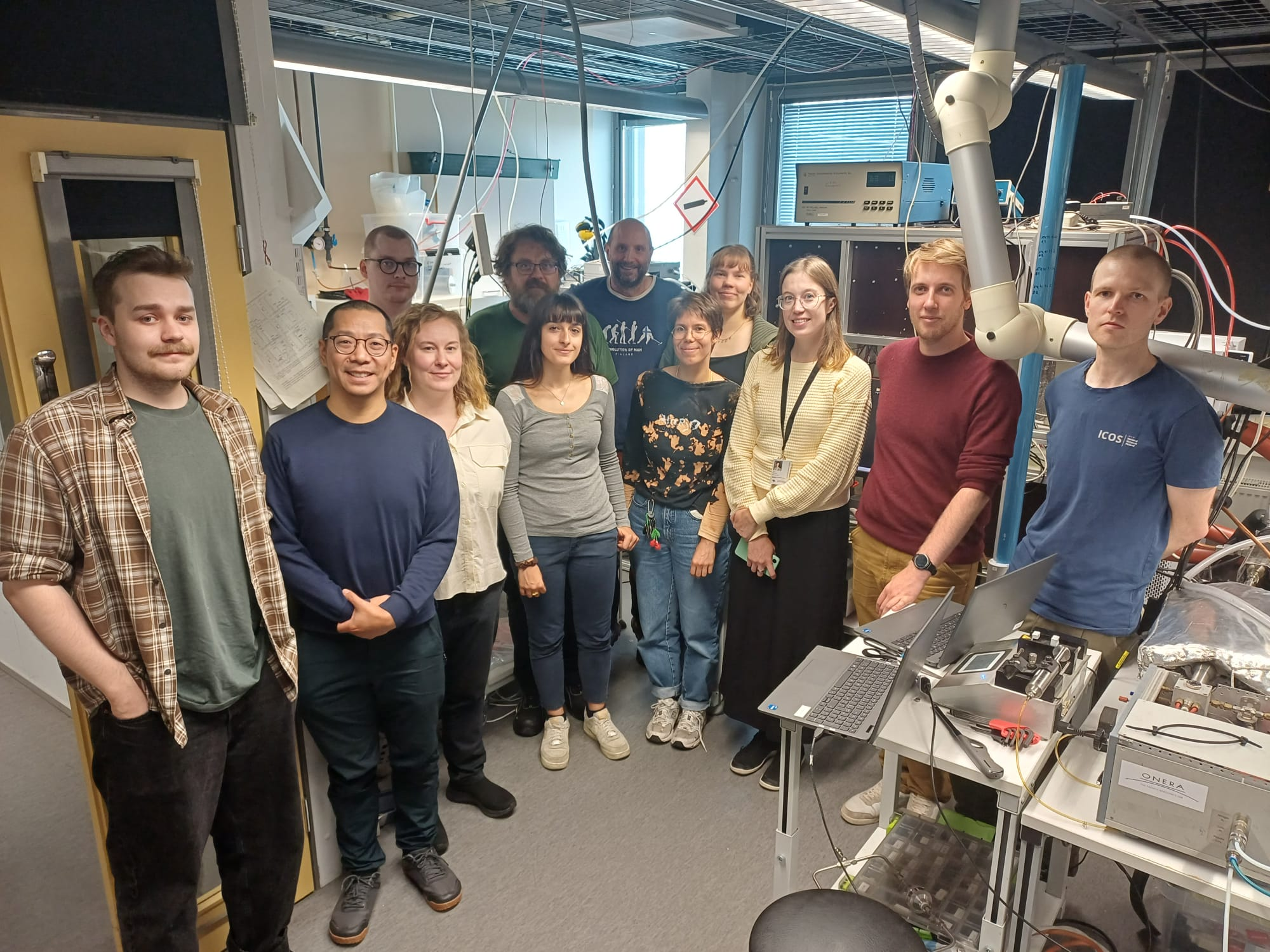
Pictured: Uuno Huuskonen (UHEL), Tommy Chan (UHEL), Nanna Myllys (UHEL), Cecilia Righi (UHEL), Deniz Kemppainen (UHEL), Nina Sarnela (UHEL), Antoine Berthier (ONERA), Pekka Rantala (UHEL). Also pictured: Tapio Elomaa (UHEL), Hannu Koskenvaara (UHEL), Jonathan Duplissy (UHEL), Iiris Valonen (UHEL).
At high altitudes, aircraft engines release exhaust gases and soot particles into very cold air. As the exhaust cools and undergoes atmospheric processing, volatile particulate matter (vPM) can form when gaseous compounds condense into new particles, or when vapours condense onto existing soot. These particles can influence the formation and properties of ice crystals and, in turn, aircraft contrails.
Contrail formation and properties vary with fuel composition, engine technology and atmospheric conditions. To investigate these processes under precisely controlled conditions, the University of Helsinki, with support from ONERA and Tampere University, developed ESCAPE within UNIC.
ESCAPE – Experimental Simulation of Clouds, Aerosol & Photochemistry Environments – is a transportable atmospheric chamber designed to reproduce high-altitude conditions at temperatures as low as −80 °C, with controlled humidity, irradiation and pressure. The facility allows researchers to study the atmospheric processing of aircraft emissions, the formation of volatile particles and the development of ice crystals.
For ESCAPE’s first experimental test, the ONERA team brought its laboratory-scale aeronautical burner, the liquid mini-CAST, to the University of Helsinki, allowing real jet-fuel combustion gases and particles to be introduced into the chamber.
Highlights of the first test:
- Stable operation at temperatures down to −50 °C
- Successful control of irradiation and humidity
- Demonstration of volatile-particle formation at −50 °C from real jet-fuel combustion emissions
This successful first campaign marks an important milestone for ESCAPE. It demonstrates the facility’s ability to investigate aircraft-emission processes under controlled, low-temperature conditions, and supports its future use in large-scale campaigns involving combustion test benches and full-scale aircraft engines.
The next major step will be the UNIC measurement campaign at SR Technics, planned for March 2027.
Many thanks to everyone who contributed to the design and development of ESCAPE, and to all participants in this first ESCAPE–mini-CAST measurement campaign.